Carbon and grease off the line, before it's baked in.
Daily wipe-downs keep a kitchen running. They don't touch the carbon that bakes onto grates, flat tops, fryer housings and racks over months of service. That's the layer ArcLight removes, on a schedule that fits your volume.
The buildup the daily list doesn't reach.
The FDA Food Code expects cooking surfaces to be kept "free of encrusted grease deposits" and nonfood-contact surfaces to be cleaned often enough that soil doesn't accumulate (FDA Food Code 2022, 4-601.11 and 4-602.13). Baked-on carbon makes that hard to keep up with by hand.
Carbonized grease
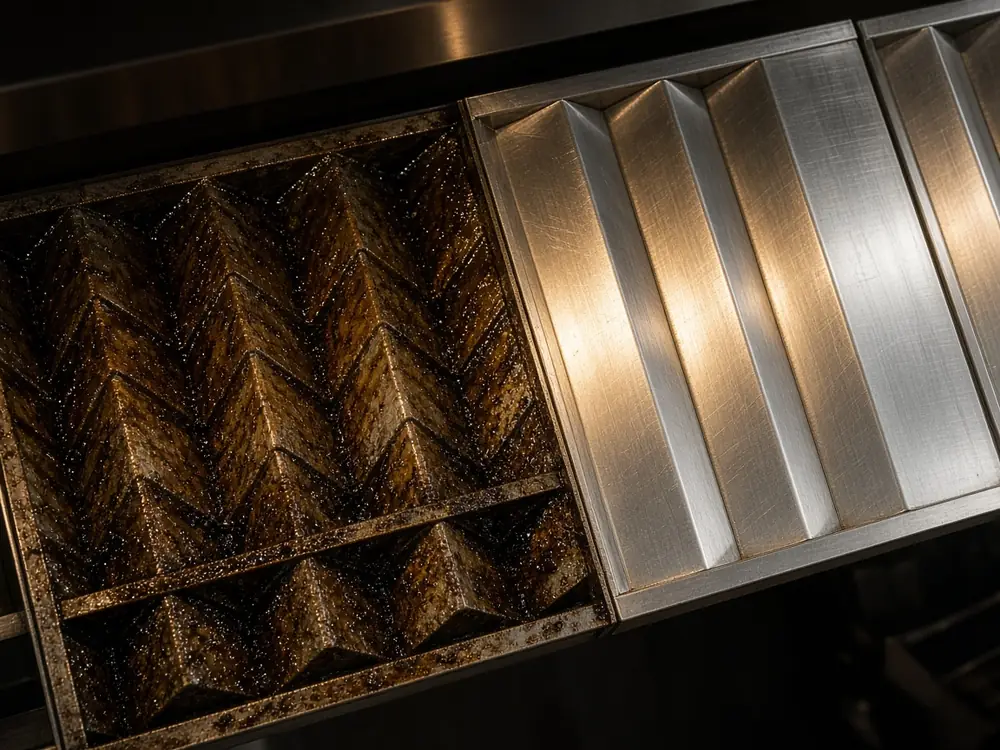
Polymerized grease and carbon that degreaser and scrub pads stop touching.
Fire and inspection risk
Grease on and around cooking equipment is fuel, and health inspectors look for encrusted grease.
Downtime
Soaking, scraping and long self-clean cycles take equipment off the line.
Kitchen equipment we laser-clean
- Grill grates and charbroiler grates
- Flat tops, griddles and burner assemblies
- Fryer bodies and oven exteriors
- Oven racks, sheet pans and smoker racks
- Removable hood baffle filters
- Stainless work tables, splash walls and carts
Where a laser isn’t the right tool
- Hood, duct and exhaust-fan cleaning certification (a separate certified service)
- Plastic parts, gaskets, seals and knobs
- Nonstick or coated surfaces you want to keep
- Cast-iron seasoning you want to keep (laser strips it to bare metal)
- Sanitizing. Food-contact parts are washed, rinsed and sanitized after cleaning.
Four steps, planned around service.
- Walkthrough
We look at the equipment, the buildup and your service hours.
- Test spot
A small area is cleaned first so you can see the result on your own equipment and we can confirm the settings.
- Cleaning
Before opening, after close or on a slow day. Marked work area, laser eye protection, fume extraction running.
- Back in service
Food-contact parts are washed, rinsed and sanitized per your health code. You get a dated record with photos.
Kitchens of every size
Restaurants and bars, hotel kitchens, school and hospital cafeterias, church and community kitchens, commissaries, food trucks, barbecue and smoker operations.
Service area: Demo placeholder service area (cities or counties)
Kitchen questions
Can you laser clean kitchen equipment?
Laser cleaning is used on metal kitchen equipment with baked-on carbon and grease, such as grill grates, flat tops, burners, fryer and oven exteriors, racks and hood filters. Every item gets a test spot first. Plastic parts, gaskets and anything the beam can't reach are left alone.
Is laser cleaning food safe?
Laser cleaning removes buildup but does not sanitize. Any food-contact part is washed, rinsed and sanitized according to your local health code before it goes back into service, as the FDA Food Code requires for food-contact surfaces. Fume extraction captures the removed material during the work.
Do you clean hoods and exhaust ducts?
Full hood, duct and exhaust-fan cleaning under NFPA 96 is a separate service done by exhaust cleaning companies, and many areas require a certified provider. ArcLight's demo scope is equipment buildup, including removable parts like baffle filters. Demo placeholder confirm whether ArcLight does any exhaust work or refers it out
How often should a restaurant hood be inspected and cleaned?
NFPA 96 sets inspection for grease buildup at monthly for solid-fuel cooking, quarterly for high-volume cooking such as 24-hour, charbroiling or wok, semiannually for moderate volume, and annually for low volume such as churches and seasonal businesses (Markel summary of NFPA 96). Cleaning is required when the inspection finds grease buildup. Your local fire code may be stricter.
How often should food-contact surfaces be cleaned?
Under the FDA Food Code, food-contact surfaces used with time/temperature-controlled food are cleaned at least every 4 hours, and food-contact surfaces of cooking and baking equipment at least every 24 hours (FDA Food Code 2022, 4-602.11 and 4-602.12). Your state or county adopts its own version, so check the local code.
Do we have to close while you clean?
The aim is to work around service, before opening, after close or on a slow day, so the line is ready for the next shift. Equipment has to be cool and the work area cleared of staff while the laser runs. Demo placeholder ArcLight's actual scheduling hours and typical time per item
Will laser cleaning remove the seasoning on cast iron?
Yes. Laser cleaning strips cast iron to bare metal, seasoning included (Pristine Laser Restoration), so seasoned grates or plancha tops need re-seasoning afterward. If you want to keep the seasoning, a laser is the wrong tool for that surface.
One useful cleaning idea, once a month.
The ArcLight newsletter: one cleaning idea, one seasonal reminder and one recent job. Short enough to read before prep. Read a sample issue.
See what precision can do for your equipment.
Send us what you’re working with. ArcLight will look at the material, the buildup and your schedule, and tell you honestly whether laser cleaning is the right tool.
Request an asset assessment